In this special edition of our newsletter, we are pleased to feature our guest contributors, Stephen Polakoff, General Counsel/Partner, and Denis Mosolov, Managing Partner at Flashpoint Venture Capital, one of the leading experts in venture capital and venture debt. Their participation will allow us to delve deeper into how this type of financing can be a strategic option for startups at different stages of their development.
Guest Contributors: Stephen Polakoff, General Counsel/Partner, and Denis Mosolov, Managing Partner, Flashpoint Venture Capital.
Even though it has been an option for founders and investors since the 90s in the US market, venture debt (“VD”) as an asset class remains poorly understood in the venture capital ecosystem. In this brief overview, we will discover how venture debt is in fact an asset class fundamentally different from both VC equity and quasi-equity investing (convertible loans) both in terms of its nature and purpose.
How many times have investors and founders alike asked me the same question – “Venture debt is just a simple loan convertible into equity, right?” The answer is a strong “no”. VD is fundamentally a debt instrument, which does not convert to equity and is being provided with the expectation that it will be repaid with interest. So what is the upside that the VD provider uses to attract limited partners to invest in its funds? That is the warrant, i.e. a right to purchase equity at a certain price. This gives the VD fund an “equity kicker” that can generate additional returns for the lender in the event that the portfolio company achieves a successful exit. Importantly, because VD does not convert to equity, it does not dilute founders and other shareholders. This non-dilutive nature is what makes it so attractive to companies.
The next question is – “I understand it is debt and not equity, but why are there so many documents?” The answer goes to the heart of the nature of VD – it is a secured loan. A loan is secured if the borrower (or a guarantor of the borrower’s obligations) grants the lender a lien or pledge over its assets and/or rights to “secure” the repayment of the loan. Typically this includes pledges over cash in bank accounts, receivables, shares of subsidiaries, intellectual property and other assets through a well-known instrument in the UK called a floating charge (garantía sobre bienes o activos cuyo valor es, por naturaleza, cambiante), or a security agreement (acuerdo de garantía) in the US.
Upon learning this, founders sometimes worry that a VD provider can swoop in and take their business if they are a day late in making a payment. Not true! While the lender does have security over the assets of the company, it does not usually have a pledge of its shares. So while the company does need to pay attention to its obligations, just like in any other contract, the lender does not have the capability to seize the company’s shares and become a shareholder. A true VD provider is also simply not interested in doing this – lenders are passive investors and are simply not equipped for managing companies in the manner that VCs or private equity is.
So what are these obligations and restrictions that a borrower has to deal with if it takes out venture debt? The good news is that venture debt lenders don’t usually impose financial covenants on the borrowers, so not meeting an ambitious business plan is not a problem. The main restrictions are to do with not paying dividends and not fundamentally changing the nature of the business (e.g. through major M&A), which are not a problem for start-ups. Once the VD loan is in place, maintenance is very simple, as the lender does not in any way interfere with the management of the company.
Now that we understand the nature of VD, let’s turn to its use cases. Fundamentally, VD is cheaper than equity – whereas a VD provider simply wants its loan and interest repaid, equity investors want returns in the multiples of their investment, which means dilution for founders. Hence the general answer is: the company should use VD whenever it can, because it should be looking for the cheapest funding available! This is particularly true in the current environment when fundraising is difficult and companies are facing the prospect of flat or down rounds. In this situation, VD is the perfect answer to soften the hit of having to raise very expensive and dilutive equity. If the company has good product-market fit, growth and either quality VC backing or a clear path to profitability, then funding its business plan at least partially with debt makes perfect sense.
Having discussed the benefits of VD to companies, let’s turn to why this is an interesting asset class for investors. Typically, two types of investors are interested in VD: i) investors who have an allocation to fixed income and are looking for interesting debt products to add to that portfolio of “boring bonds”, and ii) investors who would like a lower risk exposure to the VC ecosystem. For the first type, not only does VD provide yield enhancement through higher returns, it is also a great diversifier to a traditional fixed income portfolio. The second type of investor gets to “dip their toe” into the VC ecosystem and learn about the opportunities which exist there with their capital safely protected.
Further of interest to the investors is that, as opposed to equity funds, they start to receive return on their investment quickly in the form of distributions. Of course, less risk means less reward and VD investors will not receive the ambitious 10x returns that equity funds sometimes return. At the same time, it is very unlikely that VD investors will lose money, which unfortunately can happen with equity funds, in particular seed stage funds.
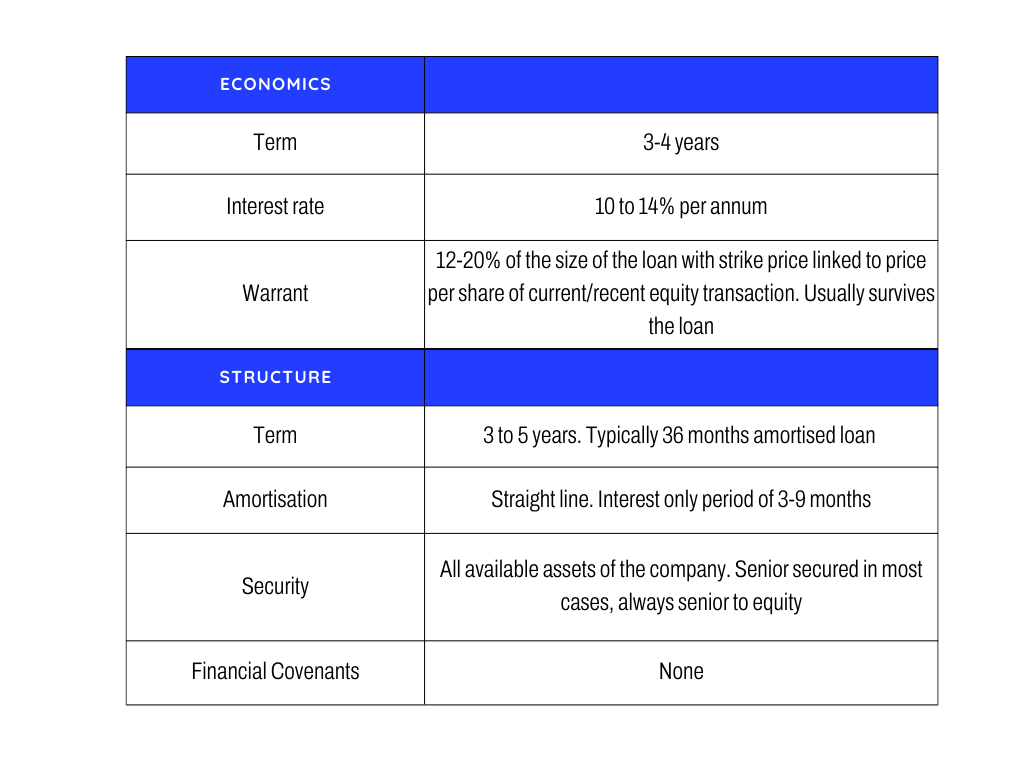
Having established that VD is a “win-win” product for both companies and investors, below is a summary of its key terms:
Key Economic and Structural terms of Flashpoint’s Growth Debt Loans
If you are interested in learning more about structuring financing through venture debt or venture capital, don’t hesitate to contact Across Legal team for specialized legal advice in these types of transactions. We would be happy to help you find the best option for your business!
#VentureDebt #VentureCapital #Startups #Financing #Investment #BusinessGrowth #LegalAdvice #Innovation #Entrepreneurship